Cévennes heritage and history, seen from the hamlet
Arfin in 1417, Brousson hidden in Arphy in 1698, silk, replanting, the 1944 maquis and the Paradis bread oven: Cévennes history, seen from here.
In 1417, a parchment mentions the "mas of Arfin, parish of Aulas" (Mansus de Arfino). It is the oldest written record of Arphy. At the time, Arphy was just a hamlet of Aulas: in 1384 there were 2 "feux", two households! The commune was only created in 1792. Here, the history of the Cévennes can be read in the names of the hamlets... and in the stones of Les Vignals.
The time of the "Désert", in the commune of Arphy
In 1685 the king banned Protestant worship. This was the start of the "Désert" (the Wilderness): a century of hidden prayer, until the Revolution. You have guessed it: in Aulas as in Arphy, most people were Protestant...
In 1698, a shepherd from Arphy called Grimal hid two preachers in his home, Bas and Claude Brousson. A cave in the commune, the Baume du Ministre, later sheltered other pastors.
Then came the Camisard war (1702-1704), led by Jean Cavalier and Roland. In Le Vigan, the judge and mayor Jacques Daudé was murdered near his house on 5 June 1704. The repression went on long after. In 1728, the pastor Alexandre Roussel was hanged in Montpellier; Aulas put up a monument to him and two other preachers in 1929. In 1732, André Verseils, from Pratcoustal (the next hamlet), was sentenced to the galleys for his faith.
Arphy's Protestant temple dates from 1877. It was paid for partly by gifts... from the Protestant consistory of Hamburg! Arphy has no church: it is officially listed as a "commune without a church".
Silk, chestnuts and forests
In the 19th century Arphy filled up: 606 inhabitants in 1841. Everywhere there were dry stone terraces (the faïsses), chestnut trees, and mulberry trees for the silkworms. In 1835 the Monna mill opened in the commune, first for cotton, then for silk. Chestnuts dried for weeks in the clèdes, the small drying houses, over a low fire.
Then came pébrine, a silkworm disease, which ruined everything between 1854 and 1867. Pasteur came to study it in Alès from 1865. The disease was beaten around 1875, but Cévennes silk never recovered. People left. Arphy fell to 86 inhabitants in 1975.
At the same time, the State was replanting the Aigoual. In 1892 it bought the Montals estate, a hamlet of Arphy, to house the forest wardens. The state forest you drive through on the way up to the col du Minier owes a lot to that work.
Where to see these traces, around the hamlet?
- The temple in Arphy (1877), in the village. Standing in front of it, you now know who paid for it!
- Aulas, on the road to Le Vigan: the preachers' monument (1929), the old bridge, the "traouquets" (narrow passages between the houses). Take the time to walk.
- The Musée Cévenol in Le Vigan, a quarter of an hour away, in an old silk mill. Odette Teissier du Cros founded it in 1963 (her family came from Aulas). Keep it for a rainy day.
- The Musée du Désert, in Mialet, in Roland's house (opened in 1911). It is 1 h 20 away. Keep it for a full day. In early September, the Assemblée du Désert is held there every year.
1944, the Maquis and Le Paradis
Summer 1944. The Aigoual-Cévennes Resistance group (the "maquis") had its headquarters in L'Espérou, half an hour from the hamlet. On 10 August 1944 it attacked Le Vigan; its leader, Commandant Marceau, was killed there.
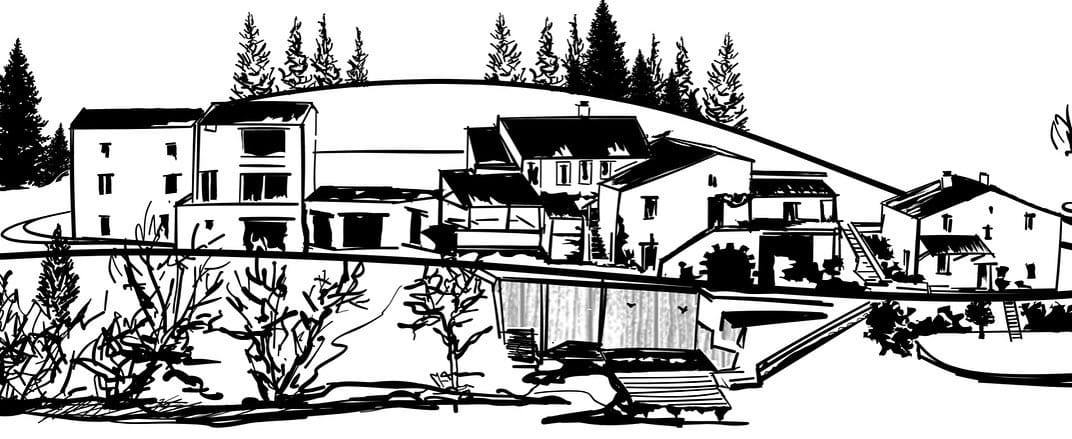
At Les Vignals there is still a photo: Resistance fighters settling into the hamlet. And a name. The smallest house is called Le Paradis, named by the maquis in 1944 because of its bread oven! The oven is still there. The full story is in the story of Le Paradis.
When Pierre and Laurence restored the hamlet, they kept everything: every beam and every stone went back in its place, with hemp and lime walls. They will tell you the story of Les Vignals, if you ask them. Would you like to sleep inside this story? Le Paradis sleeps up to 4 people (careful, it is not suitable for young children). The other houses of the hamlet sleep up to 12.
And for the Baume du Ministre, ask Pierre and Laurence before you go looking for it in the woods...